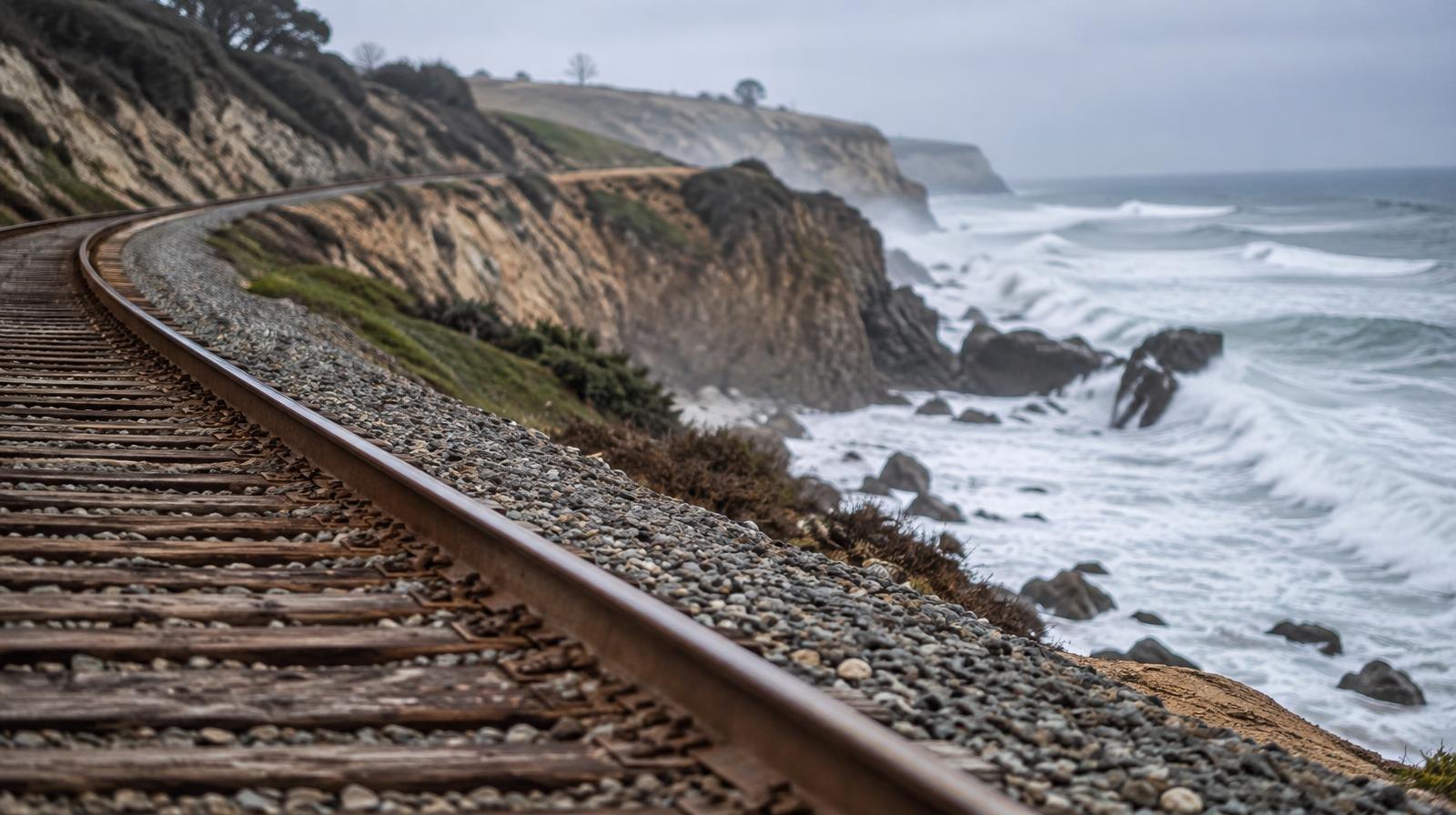
A single landslide along Del Mar's bluff-top railroad tracks could halt every train in and out of San Diego. Scientists at Scripps Institution of Oceanography say a strengthening El Niño is raising the odds.
About 1.7 miles of the Los Angeles-San Diego-San Luis Obispo (LOSSAN) Rail Corridor runs along a high seaside bluff in Del Mar, the San Diego Union-Tribune reported. The corridor carries daily Amtrak and Coaster commuter trains and nightly BNSF freight service. Transit agencies have spent decades installing seawalls, retaining walls and pilings to stabilize the slopes, but one slide could shut down the line until emergency repairs are finished.
Warmer ocean water driven by El Niño could add 6 to 12 inches to background sea levels, according to climate scientists at Scripps. That extra water becomes a serious threat when it coincides with king tides, the highest tides of the year. King tides are expected to peak on or about Oct. 27, Nov. 24, Dec. 24 and Jan. 22, 2027.
Adam Young, a coastal geomorphologist with the Scripps Coastal Processes Group, said the tides "really increase the chance for damage along our coastline" at a gathering of scientists at Scripps in La Jolla in October. In a September report by the New York Post, Young said strong El Niño conditions "can raise sea level on the California coast by six to 13 inches" and can "threaten public parks, beaches, critical infrastructure, highways, and homes."
Solana Beach bluff-top homeowners face heightened risk as well. Residents there have fought erosion for years by adding, expanding or rebuilding seawalls, the Union-Tribune reported. Storms during the 2026–27 winter season could bring new hazards for those properties if they match the forecast.
Scripps Pier in La Jolla recorded 51 days of record-high surface water temperatures in 2026 as of Oct. 13, according to the Scripps website.
Julie Kalansky, a climate scientist at Scripps, cautioned that uncertainty remains. "El Niño only sets that stage and tilts the odds toward more extreme weather," Kalansky said.
Gov. Gavin Newsom declared a state of emergency on Sept. 21 to bolster El Niño preparedness statewide. The proclamation directs state agencies to protect vulnerable communities, prepare roads and critical infrastructure, and reduce flood, landslide and coastal risks.
Long-term plans call for relocating the Del Mar rail segment inland through a tunnel near Interstate 5. Planners have said the project could be finished by 2035, but the Union-Tribune reported that target may be optimistic, and the solution remains unfunded at an estimated cost of billions of dollars.